


Introduction:
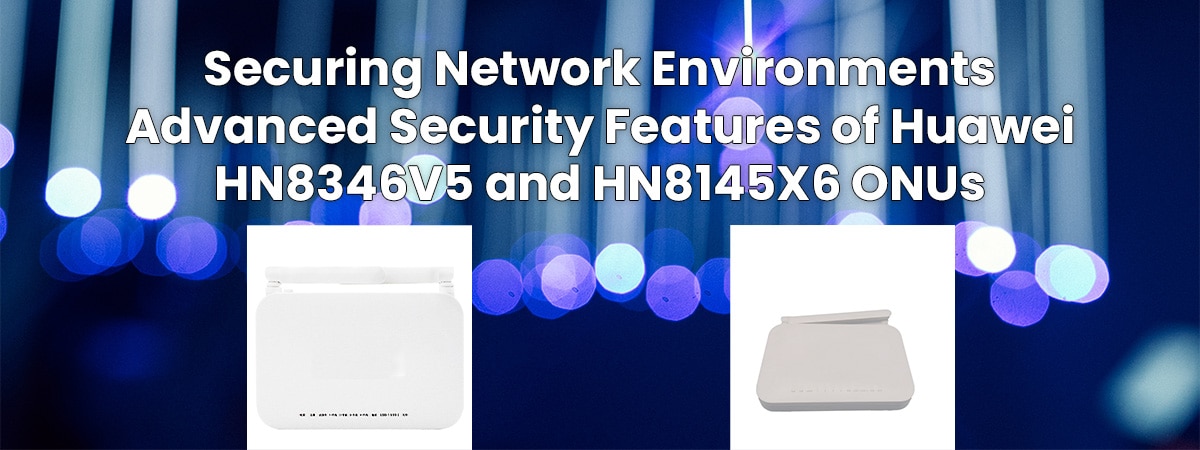
In today’s digital landscape, ensuring the security of network environments is of paramount importance. Huawei, a leading telecommunications company, has incorporated advanced security features into their HN8346V5 and HN8145X6 Optical Network Units (ONUs). In this article, we will explore the robust security measures integrated into these ONUs, including firewall protection, encryption protocols, and access control mechanisms. We will discuss how these features work together to establish a secure network environment for users.
- Firewall Protection:
Highlight the firewall protection feature of the HN8346V5 and HN8145X6 ONUs. Explain how the built-in firewall acts as a barrier between the internal network and external threats, such as unauthorized access attempts or malicious activities. Discuss how the firewall filters incoming and outgoing network traffic based on predefined rules, effectively safeguarding the network against potential threats. - Encryption Protocols:
Discuss the encryption protocols supported by the HN8346V5 and HN8145X6 ONUs, such as WEP (Wired Equivalent Privacy), WPA (Wi-Fi Protected Access), or WPA2 (Wi-Fi Protected Access 2). Explain how these protocols encrypt data transmission over the network, ensuring that sensitive information remains secure and protected from unauthorized interception. - Access Control Mechanisms:
Highlight the access control mechanisms implemented in the HN8346V5 and HN8145X6 ONUs. Discuss features such as MAC (Media Access Control) address filtering, which allows network administrators to specify which devices can connect to the network. Explain how this mechanism prevents unauthorized devices from gaining access to the network, enhancing overall network security. - User Authentication:
Explain the user authentication capabilities of the HN8346V5 and HN8145X6 ONUs. Discuss authentication protocols such as PPP (Point-to-Point Protocol) or RADIUS (Remote Authentication Dial-In User Service). Illustrate how these protocols validate the identity of users before granting them access to the network, protecting against unauthorized access attempts. - Vulnerability Management:
Discuss how the HN8346V5 and HN8145X6 ONUs incorporate vulnerability management features. Explain how these features allow network administrators to identify and address vulnerabilities in the network environment promptly. Discuss the importance of firmware updates and patch management to ensure that the ONUs are equipped with the latest security enhancements. - Remote Management and Monitoring:
Highlight the remote management and monitoring capabilities of the HN8346V5 and HN8145X6 ONUs. Explain how network administrators can remotely access and configure the ONUs, enabling them to monitor network activity, detect anomalies, and respond to security incidents proactively. Emphasize the importance of regular monitoring to maintain a secure network environment.
Conclusion:
The Huawei HN8346V5 and HN8145X6 ONUs go beyond delivering high-speed internet connectivity by prioritizing the security of network environments. Through features such as firewall protection, encryption protocols, access control mechanisms, user authentication, vulnerability management, and remote management capabilities, these ONUs establish a secure network environment. By leveraging these advanced security measures, users can enjoy peace of mind, knowing that their data and network are protected against potential threats.