
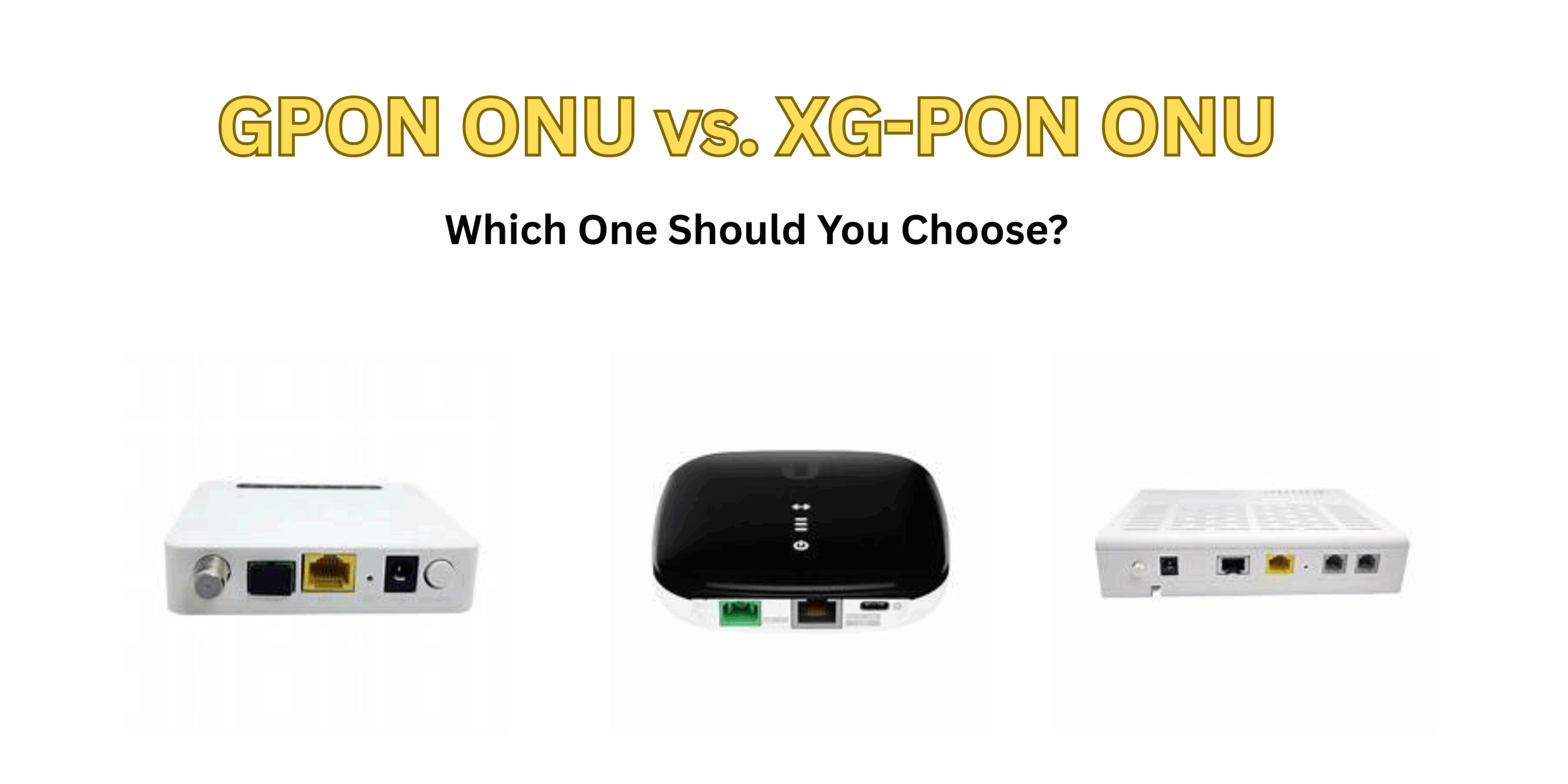
As the demand for high-speed internet continues to rise, service providers must choose the right ONU (Optical Network Unit) to deliver efficient, cost-effective, and future-proof fiber connectivity. The decision between GPON ONU, XG-PON ONU, and other next-generation solutions directly impacts network performance, user experience, and long-term scalability. Understanding the differences between these technologies will help determine the best option for your next-gen fiber network, ensuring high-speed, low-latency internet for residential and business users.
What is an ONU and Why is it Important?
An Optical Network Unit (ONU) is a crucial component in fiber-optic broadband infrastructure. It connects end-users to the network by converting optical signals from the OLT (Optical Line Terminal) into electrical signals that home or business devices can use. ONU selection is critical for service providers because it determines network speed, efficiency, and overall performance.
With increasing internet consumption—driven by 4K/8K video streaming, cloud computing, IoT devices, and 5G backhaul—choosing the right ONU is more important than ever. The most common options are GPON ONU and XG-PON ONU, each with unique advantages and limitations.
What is GPON ONU?
GPON ONU (Gigabit Passive Optical Network ONU) is widely used for Fiber-to-the-Home (FTTH) and Fiber-to-the-Premises (FTTP) applications. It operates on GPON (Gigabit Passive Optical Network) technology, a well-established fiber broadband standard that balances cost, speed, and efficiency.
Key Features of GPON ONU
- Speed: Provides 2.5 Gbps downstream and 1.25 Gbps upstream.
- Splitting Ratio: Connects up to 32 to 64 users per fiber from the OLT.
- Technology: Uses Time Division Multiplexing (TDM-PON) to share bandwidth efficiently.
- Use Cases: Ideal for residential broadband, small businesses, and VoIP services.
- Cost: Affordable and widely supported, making it a go-to solution for large-scale deployments.
Advantages of GPON ONU
✔ Cost-effective for mass deployments in residential areas.
✔ Sufficient speed for most home and small-business applications.
✔ Reliable and stable, with broad vendor support.
✔ Energy-efficient, reducing power consumption.
Limitations of GPON ONU
✖ Limited bandwidth, making it unsuitable for data-intensive applications.
✖ Higher latency compared to newer PON technologies.
✖ Not future-proof, as demand for faster speeds increases.
GPON ONU remains a strong choice for basic broadband needs, but as internet consumption grows, many service providers are shifting towards XG-PON ONU for higher-speed performance.
What is XG-PON ONU?
XG-PON ONU (10-Gigabit Passive Optical Network ONU) is an advanced version of GPON ONU, designed to meet the demands of next-gen fiber networks by providing significantly faster speeds and lower latency.
Key Features of XG-PON ONU
- Speed: Supports 10 Gbps downstream and 2.5 Gbps upstream.
- Splitting Ratio: Matches GPON at 1:32 or 1:64, allowing easy upgrades.
- Technology: Uses TDM-PON, like GPON, but with enhanced capabilities.
- Use Cases: Ideal for enterprise networking, smart cities, 5G fronthaul/backhaul, and IoT applications.
- Upgrade Path: Backward compatible with GPON, simplifying network transitions.
Advantages of XG-PON ONU
✔ 4x faster downstream speeds than GPON ONU.
✔ Low latency, ideal for gaming, cloud computing, VR, and IoT.
✔ Supports high-bandwidth applications like smart cities and remote work.
✔ Future-proof, allowing seamless integration with next-generation fiber networks.
Limitations of XG-PON ONU
✖ Higher cost compared to GPON ONU.
✖ Requires infrastructure upgrades to fully utilize 10G speeds.
✖ Asymmetrical bandwidth, which may not suit all enterprise needs.
For businesses and service providers aiming for high-performance networks, XG-PON ONU is a logical upgrade, delivering superior speed and efficiency.
Comparing GPON ONU vs. XG-PON ONU
| Feature | GPON ONU | XG-PON ONU |
| Downstream Speed | 2.5 Gbps | 10 Gbps |
| Upstream Speed | 1.25 Gbps | 2.5 Gbps |
| Splitting Ratio | 1:32 or 1:64 | 1:32 or 1:64 |
| Latency | Moderate | Low |
| Technology Type | TDM-PON | TDM-PON |
| Upgrade Complexity | Low | Medium |
| Ideal Use Cases | Residential broadband, small businesses | Enterprises, smart cities, 5G backhaul |
| Cost Efficiency | High (cheapest) | Medium (higher cost) |
Which ONU Should You Choose?
Choose GPON ONU If:
✔ You need a low-cost broadband solution for residential users.
✔ Your network serves home users and small businesses with moderate bandwidth needs.
✔ You are deploying basic services like web browsing, VoIP, and standard video streaming.
Choose XG-PON ONU If:
✔ You require faster speeds for business applications, cloud computing, or remote work.
✔ Your network needs low latency for gaming, smart cities, or IoT.
✔ You want a future-proof ONU that supports next-gen fiber networks.
The Future of ONU Technology
- Hybrid Deployments
- Many service providers now offer GPON ONU for residential areas and XG-PON ONU for businesses and high-demand users.
- 5G-Ready Fiber Networks
- XG-PON ONU is playing a critical role in 5G backhaul, ensuring ultra-fast and low-latency connectivity.
- AI-Powered Network Management
- Future ONUs will integrate AI for automated traffic optimization and predictive maintenance.
- NG-PON2 Evolution
- Beyond XG-PON ONU, NG-PON2 ONU will introduce multi-wavelength capabilities for even greater bandwidth efficiency.
Conclusion
The choice between GPON ONU and XG-PON ONU depends on network needs, performance requirements, and future scalability.
- GPON ONU is still the best option for cost-effective, basic broadband services.
- XG-PON ONU provides higher speeds, lower latency, and future-proofing for business, smart cities, and high-performance applications.
For service providers looking to stay ahead in the next-gen fiber network race, XG-PON ONU is the smarter long-term investment, ensuring superior speed, efficiency, and scalability.