


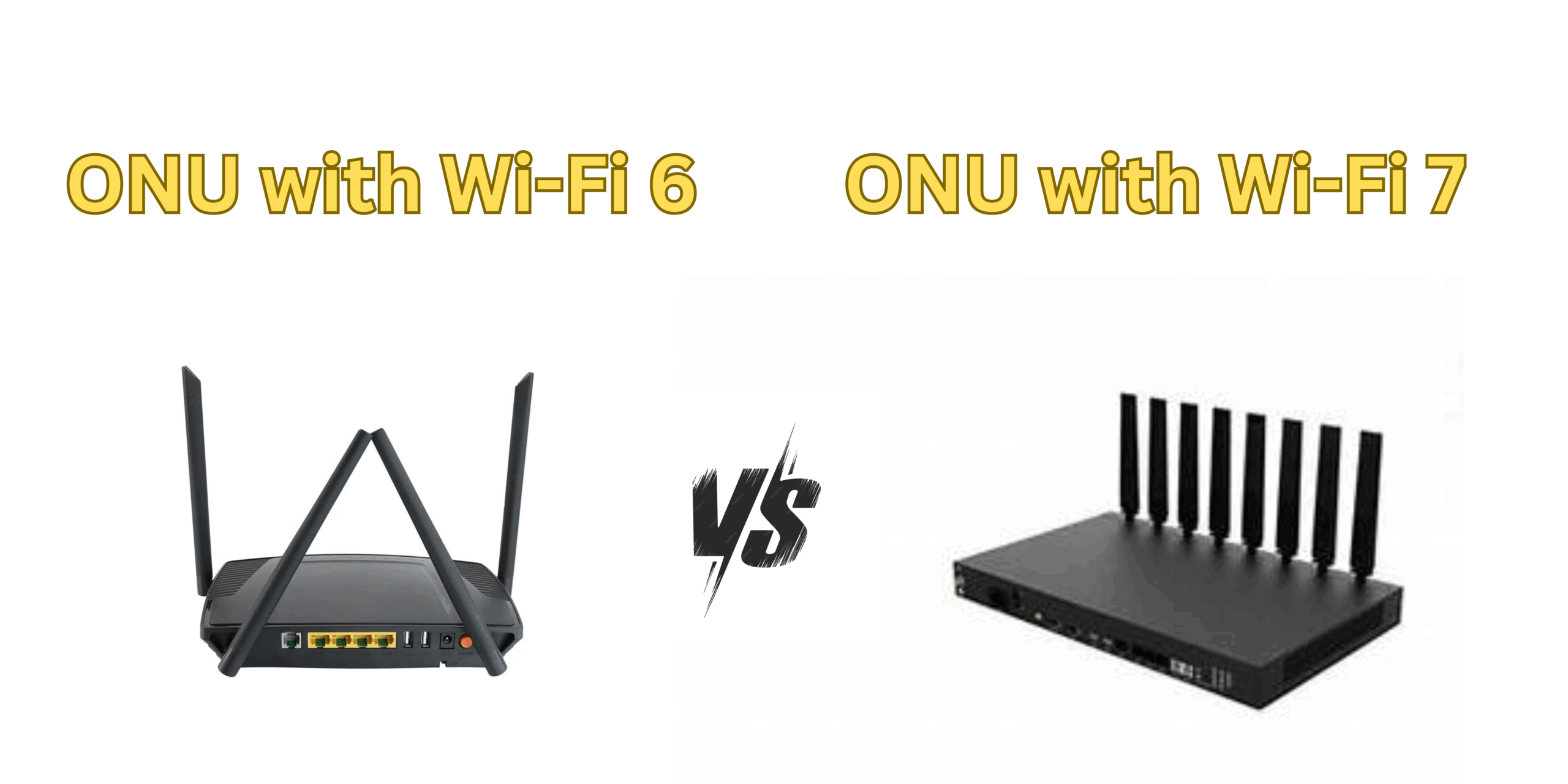
As internet usage continues to grow, service providers and consumers are looking for ways to improve network speed, reliability, and efficiency. The latest advancements in Wi-Fi technology have brought Wi-Fi 7, promising higher speeds, lower latency, and better performance compared to Wi-Fi 6. With ONU (Optical Network Unit) devices now integrating these new wireless standards, the question arises: Is upgrading from an ONU with Wi-Fi 6 to an ONU with Wi-Fi 7 worth it?
Choosing the right ONU is critical for maintaining a next-gen fiber network that can handle increasing bandwidth demands. This article compares the two technologies, outlining the key differences, advantages, and considerations for upgrading.
What is an ONU and Why is Wi-Fi Important?
An ONU (Optical Network Unit) is a device that connects end users to a fiber-optic network. It converts optical signals from the OLT (Optical Line Terminal) into electrical signals that devices like computers, smartphones, and smart TVs can use. Many ONUs now come with built-in Wi-Fi, allowing seamless wireless connectivity without the need for a separate router.
With the explosion of 4K/8K streaming, smart home devices, cloud gaming, and IoT applications, Wi-Fi technology plays a critical role in delivering fast, stable, and low-latency connections. The choice between ONU with Wi-Fi 6 and ONU with Wi-Fi 7 will determine the overall network experience and future scalability.
What is ONU with Wi-Fi 6?
Wi-Fi 6 (802.11ax) is the current mainstream Wi-Fi standard, offering higher speeds, better efficiency, and improved capacity compared to Wi-Fi 5. ONUs with Wi-Fi 6 are widely used in homes and businesses due to their ability to handle multiple connected devices efficiently.
Key Features of ONU with Wi-Fi 6
- Speed: Supports speeds up to 9.6 Gbps (combined across multiple channels).
- OFDMA (Orthogonal Frequency Division Multiple Access): Allows multiple devices to communicate simultaneously, reducing network congestion.
- MU-MIMO (Multi-User Multiple Input Multiple Output): Enhances network performance by enabling simultaneous data transmission to multiple devices.
- 1024-QAM (Quadrature Amplitude Modulation): Increases data transmission rates by encoding more data per signal.
- Target Wake Time (TWT): Reduces power consumption for IoT and smart home devices by scheduling wake-up times efficiently.
Advantages of ONU with Wi-Fi 6
✔ Faster speeds compared to previous Wi-Fi generations.
✔ Better efficiency in managing multiple connected devices.
✔ Lower latency, making it suitable for gaming and video conferencing.
✔ Improved power efficiency, enhancing battery life for IoT devices.
Limitations of ONU with Wi-Fi 6
✖ Limited to 160 MHz channel width, which restricts peak performance.
✖ Still struggles with congestion in very high-density environments.
✖ Not optimized for next-gen applications like AR/VR and ultra-HD cloud gaming.
While ONU with Wi-Fi 6 is an excellent choice for most users, Wi-Fi 7 offers even greater advancements in speed, efficiency, and overall performance.
What is ONU with Wi-Fi 7?
Wi-Fi 7 (802.11be) is the next major upgrade in wireless technology, designed to maximize speed, reduce latency, and improve efficiency even further. It builds on Wi-Fi 6’s foundation while introducing several key innovations.
Key Features of ONU with Wi-Fi 7
- Speed: Supports speeds up to 46 Gbps, nearly 5 times faster than Wi-Fi 6.
- 4K-QAM (Quadrature Amplitude Modulation): Improves data transmission efficiency by 20% over Wi-Fi 6’s 1024-QAM.
- 320 MHz Channel Width: Doubles the bandwidth of Wi-Fi 6, allowing more data to be transmitted at once.
- Multi-Link Operation (MLO): Enables devices to connect to multiple frequency bands simultaneously (2.4 GHz, 5 GHz, and 6 GHz), reducing congestion and increasing reliability.
- Preamble Puncturing: Enhances spectrum efficiency by dynamically adjusting frequency channels to avoid interference.
- Ultra-Low Latency: Optimized for cloud gaming, AI-driven applications, augmented reality (AR), and virtual reality (VR).
Advantages of ONU with Wi-Fi 7
✔ Up to 5x faster than Wi-Fi 6, ideal for high-performance applications.
✔ Lower latency, making it perfect for real-time applications.
✔ Better congestion handling, ensuring smooth performance even in high-density environments.
✔ Simultaneous multi-band connections, enhancing reliability and speed.
Limitations of ONU with Wi-Fi 7
✖ Higher cost compared to Wi-Fi 6 ONUs.
✖ Requires Wi-Fi 7-compatible devices to unlock full benefits.
✖ Not yet widely available, with full adoption expected in the coming years.
ONU with Wi-Fi 7 is a revolutionary advancement, but is the upgrade necessary for everyone?
Comparing ONU with Wi-Fi 6 vs. ONU with Wi-Fi 7
| Feature | ONU with Wi-Fi 6 | ONU with Wi-Fi 7 |
| Max Speed | 9.6 Gbps | 46 Gbps |
| Modulation | 1024-QAM | 4K-QAM (20% higher efficiency) |
| Channel Width | 160 MHz | 320 MHz (2x wider) |
| Latency | Low | Ultra-low |
| Multi-Link Operation (MLO) | No | Yes |
| Ideal Use Cases | Home broadband, smart devices, gaming | AI, AR/VR, ultra-HD streaming, cloud gaming |
| Cost Efficiency | High | Medium (higher initial cost) |
Should You Upgrade to ONU with Wi-Fi 7?
Choose ONU with Wi-Fi 6 If:
✔ You need a cost-effective and reliable Wi-Fi solution for home or business use.
✔ Your internet plan is under 1 Gbps, meaning Wi-Fi 7 won’t significantly improve speeds.
✔ Your primary applications include video streaming, web browsing, and general online tasks.
Choose ONU with Wi-Fi 7 If:
✔ You require extremely fast and low-latency Wi-Fi for cloud gaming, AI, AR/VR, and ultra-HD streaming.
✔ You want a future-proof ONU that supports next-gen fiber network demands.
✔ You operate in a high-density environment where multiple devices require simultaneous high-speed access.
The Future of Wi-Fi and Fiber Networks
- Mass Adoption of Wi-Fi 7
- As more devices become Wi-Fi 7 compatible, upgrading ONUs will become necessary to fully leverage its potential.
- Integration with 5G and AI
- Next-gen fiber networks will incorporate Wi-Fi 7, AI-driven optimizations, and 5G backhaul for unprecedented speed and reliability.
- Smart Cities and IoT Expansion
- Wi-Fi 7’s capabilities will play a crucial role in the development of autonomous vehicles, AI-driven smart homes, and real-time cloud computing.
Conclusion
The transition from ONU with Wi-Fi 6 to ONU with Wi-Fi 7 represents a significant leap in wireless speed, efficiency, and network reliability. However, whether it’s worth upgrading depends on your network needs, device compatibility, and budget.
For most residential users, ONU with Wi-Fi 6 remains a solid choice, providing high-speed and reliable connectivity at a lower cost. However, if you require next-level performance for cloud gaming, AR/VR, AI applications, or ultra-HD streaming, then ONU with Wi-Fi 7 is the better investment for next-gen fiber networks.
As technology advances, ONU with Wi-Fi 7 will become the new standard, making now the perfect time to evaluate your network infrastructure and prepare for the future of high-speed fiber broadband.