
1. Why GPON Card Selection Dictates Fiber Network Success
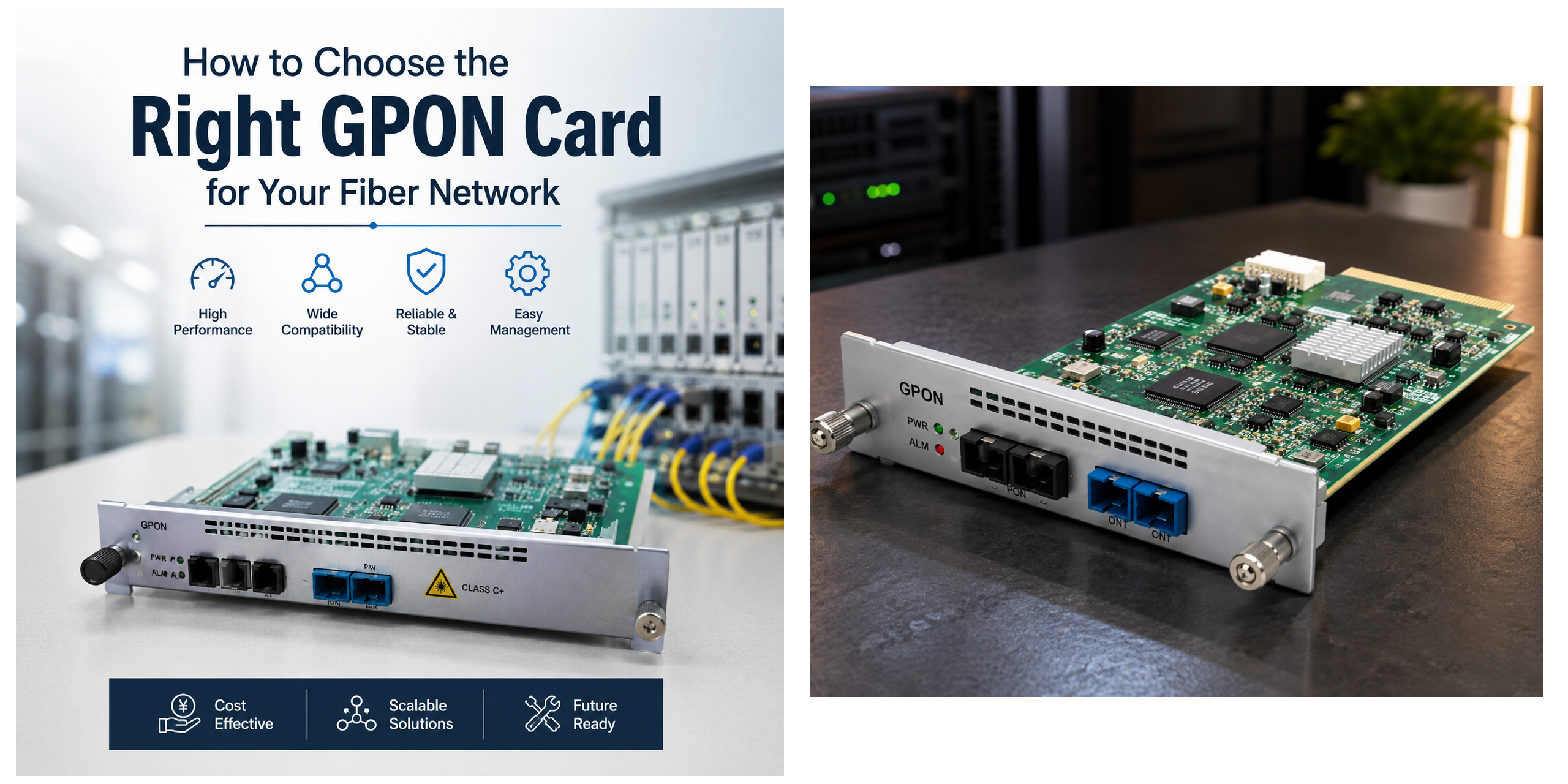
Selecting the appropriate optical hardware is the foundational step in building a resilient fiber network. The core of this selection process lies in choosing a GPON Card that aligns perfectly with both current subscriber loads and future expansion plans. A poorly matched optical module creates immediate bottlenecks, degrading signal quality and causing chronic latency issues across the entire distribution network.
Global fiber-to-the-home (FTTH) penetration reached unprecedented levels in 2025, with global subscriptions surpassing 1.5 billion. Industry forecasts for 2026 project a massive acceleration in 10G-PON migrations as consumer demand for symmetric bandwidth intensifies. This rapid evolution means that infrastructure built on outdated or rigid optical standards faces immediate obsolescence.
For wholesale buyers and network operators, this trend necessitates a shift away from generic procurement. Sourcing a GPON OLT Card through bulk channels requires strict adherence to future-proof technical specifications. Customization becomes critical here, allowing buyers to specify exact optical budgets and port configurations that eliminate wasted capacity and optimize capital expenditure.
The ripple effect of a strategic hardware choice determines the long-term viability of the network. By prioritizing scalability and wholesale flexibility during the initial selection phase, operators ensure their infrastructure can dynamically adapt to emerging technologies without requiring disruptive, costly overhauls.
1.1. How GPON Infrastructure Evolves in 2025 and Beyond
The architectural shift in passive optical networks is moving decisively from basic connectivity toward ultra-low-latency, high-throughput environments. Modern networks are no longer just dumb pipes; they are intelligent ecosystems that require sophisticated processing at the optical line terminal level. This evolution places immense pressure on the GPON Line Card to handle complex routing and bandwidth allocation natively.

Data from early 2025 indicates a 40% year-over-year increase in XGS-PON and NG-PON2 deployments across Tier 1 markets. Looking ahead to 2026, analysts expect AI-driven traffic to mandate the integration of machine learning chips directly into optical modules for predictive bandwidth management. Hardware lacking this forward-looking architectural headroom will simply fail to process next-generation data flows.
Wholesale buyers must pivot their procurement strategies to match this rapid technological progression. Sourcing bulk units that lack firmware-upgradeable pathways or modular physical interfaces is a severe liability. Engaging with manufacturers to customize optical components ensures that the hardware can support software-defined networking (SDN) implementations as they become standardized.
This ongoing infrastructure evolution mandates that procurement teams view optical hardware not as a static commodity, but as a dynamic platform. Securing the right customizable builds today provides the physical foundation necessary to ingest the complex, AI-heavy data streams expected to dominate global networks by 2026.
1.2. Why Wholesale Procurement Shifts the Cost Paradigm
Understanding the financial mechanics of network deployment reveals that the true cost of hardware extends far beyond the initial purchase price. Total cost of ownership (TCO) includes power consumption, rack space utilization, maintenance labor, and eventual upgrade pathways. Bulk acquisition fundamentally alters this financial equation by driving down the per-port cost to highly competitive margins.
Market analysis from mid-2025 demonstrates that strategic wholesale GPON Card acquisitions reduce baseline infrastructure costs by up to 35% compared to fragmented retail purchasing. Projections for 2026 suggest further market consolidation among top-tier optical component manufacturers, which will inevitably tighten pricing for buyers who lack established bulk partnerships.
Businesses respond to these economic pressures by transitioning from ad-hoc purchasing to centralized, contract-based wholesale agreements. Customization plays a pivotal role in this economic shift, as it allows operators to strip away unnecessary premium features from a GPON OLT Card while heavily investing in the specific optical components that match their deployment scenario.
This paradigm shift fundamentally restructures capital allocation for telecommunications providers. By leveraging wholesale pricing and tailored hardware configurations, enterprises can liberate significant capital, redirecting those funds toward aggressive market expansion and customer acquisition rather than being tied up in rigid, over-specified inventory.
1.3. Which Performance Metrics Matter Most for B2B Buyers
Evaluating optical hardware requires B2B buyers to look past basic throughput advertising and scrutinize the performance metrics that guarantee operational stability. Key indicators include optical sensitivity, saturation power levels, and the ability to maintain zero packet loss under maximum concurrent load. These technical parameters determine whether a network can reliably support strict enterprise service level agreements (SLAs).

Current 2025 industry benchmarks dictate that a high-quality GPON Card must flawlessly manage over 128 concurrent optical network terminals (ONTs) per port without latency spikes. As we approach 2026, the baseline standard will shift dramatically, requiring sub-5ms latency management and advanced dynamic bandwidth allocation (DBA) algorithms to handle fluctuating enterprise workloads effectively.
Generic wholesale suppliers frequently obscure these critical metrics behind vague marketing terms. The true differentiator for a buyer is securing a manufacturer willing to customize testing protocols and provide granular data on how a GPON Line Card performs under specific, simulated traffic profiles, such as prioritizing business-class traffic over residential streaming.
Prioritizing these exact, verifiable performance metrics during the request for proposal (RFP) process guarantees operational reliability. It ensures that the selected hardware will perform flawlessly under the stressful, unpredictable conditions of a live commercial deployment rather than merely surviving a sanitized laboratory environment.
2. How to Evaluate a GPON OLT Card for Scalability
Scalability is the operational lifeline of any growing fiber network. It determines how efficiently the infrastructure can support new subscribers. When evaluating a GPON OLT Card, analyze chassis compatibility, physical form factors, and software licensing. A card with low port density can quickly limit future network expansion.
Industry forecasts for late 2025 show that telecom operators without modular scalability may face up to 50% higher network upgrade costs. By 2026, plug-and-play compatibility across multiple chassis generations is expected to become a standard requirement. This change will affect both Tier 1 and Tier 2 operators.
The shift also impacts wholesale purchasing strategies. Organizations should invest in a modular GPON Line Card that integrates with existing infrastructure. This approach avoids costly forklift upgrades and protects previous capital investments.
Scalability is ultimately about future-proofing your network. Check the hardware dimensions and chassis compatibility before making a purchase. Also, confirm that the software supports dynamic provisioning as subscriber numbers grow. A scalable GPON solution helps reduce long-term costs while extending the lifespan of your fiber network.
2.1. Why Port Density Determines Long-Term ROI
Port density indicates spatial efficiency and power optimization. This matters greatly in constrained central offices. Maximizing optical ports per GPON Line Card reduces physical footprints. It takes less space to serve a subscriber base. This optimization cascades downward to reduce cooling needs. It ultimately lowers the overall power draw.
Recent 2025 telecom reports highlight a key trend. High-port-density GPON Card models reduce power consumption per subscriber. They achieve an average reduction of 20%. Global energy regulations will tighten heading into 2026. Thermal efficiency will become a strict compliance requirement. It will no longer be just an operational preference. This shift will heavily impact operational budgets.
Buyers should seek wholesale partnerships offering varied density configurations. Customizing a GPON OLT Card perfectly populates a chassis. This prevents a common network inefficiency. You avoid powering multiple half-empty racks. That specific scenario quietly drains operational expenditure. It wastes money over years of continuous deployment.
Maximizing port density transforms constrained facilities. Tailored wholesale procurement creates high-yield revenue generators. This strategy utilizes rack space effectively. It remains a highly controllable method for operators. It directly drives long-term return on investment in fiber optics.
2.2. How Split Ratios Impact Network Architecture
The split ratio determines how optical power is divided among users on a single port. It plays a key role in designing the outside fiber network. A higher split ratio enables one GPON Line Card to serve more subscribers. However, it also reduces the available bandwidth for each user. Finding the right balance is essential for efficient network design.
A 1:64 split ratio was the industry standard in 2024. However, deployment data from 2025 shows a growing shift toward 1:128 ratios for dense fiber-to-the-home (FTTH) deployments. By 2026, dynamic split ratio technology is expected to become commercially available. This technology will automatically adjust bandwidth allocation based on real-time network traffic.
Wholesale buyers should compare these trends with their service requirements. They should also consider subscriber density and geographic coverage. Hardware customization allows operators to order GPON cards with pre-configured split ratios. For example, 1:32 is ideal for business parks, while 1:128 suits high-density apartment complexes. This approach reduces field configuration time and lowers deployment costs.
Understanding split ratio requirements helps organizations choose the right hardware. It ensures the network matches the provider’s business model and performance goals. Proper planning also helps deliver consistent bandwidth without requiring early upgrades to the fiber distribution network.
2.3. Which Customization Options Solve Unique Deployment Challenges
Standard optical hardware often struggles in extreme environments or specialized network topologies. Remote locations, industrial facilities, and harsh climates create challenges that generic components cannot handle. Choosing the right hardware modifications is essential for reliable deployment.
A 2025 survey of global network operators found that 65% experienced deployment delays because of hardware incompatibilities or environmental failures. Industry projections for 2026 also predict strong demand for climate-resistant and remotely managed optical units. This growth is driven by expanding fiber networks into more remote and demanding locations.
These trends encourage B2B organizations to work with OEM partners that provide factory-level customization. A customized GPON OLT Card can include an extended operating temperature range, anti-corrosive coatings, or specially keyed optical connectors. These modifications solve compatibility issues before the equipment reaches the installation site.
Customization turns standard hardware into a purpose-built solution. It speeds up deployment, reduces on-site troubleshooting, and improves long-term network reliability. It also helps ensure stable performance in environments where standard hardware is more likely to fail.
3. Which GPON Line Card Specifications Align with Modern Demands
Aligning hardware specifications with modern network demands requires careful evaluation. Focus on optical performance, processing power, and security features. A modern GPON Card is more than a passive device. It encrypts data, manages traffic queues, and monitors optical signal levels.
In 2025, competitive optical modules commonly include advanced wavelength division multiplexing (WDM) support and hardware-based AES-256 encryption. Industry trends for 2026 also point to the adoption of AI-powered optical monitoring chips. These chips can detect potential signal issues and enable predictive maintenance before performance declines.
Wholesale buyers should look beyond basic specification sheets. They should request detailed hardware customization from their supplier. A reliable GPON Line Card provider can adjust optical budget settings, optimize transceiver power levels, and increase MAC address table capacity. These changes help match the network’s coverage area and subscriber density.
Meeting these technical requirements ensures reliable network performance. It also provides the processing power and optical efficiency needed for 8K video streaming, cloud computing, and industrial automation. As a result, the network can support demanding applications with minimal service degradation.
3.1. Why Bandwidth and PON Standards Cannot Be Ignored
Aligning hardware specifications with modern network demands requires careful evaluation. Focus on optical performance, processing power, and security features. A modern GPON Card is more than a passive device. It encrypts data, manages traffic queues, and monitors optical signal levels.
In 2025, competitive optical modules commonly include advanced wavelength division multiplexing (WDM) support and hardware-based AES-256 encryption. Industry trends for 2026 also point to the adoption of AI-powered optical monitoring chips. These chips can detect potential signal issues and enable predictive maintenance before performance declines.
Wholesale buyers should look beyond basic specification sheets. They should request detailed hardware customization from their supplier. A reliable GPON Line Card provider can adjust optical budget settings, optimize transceiver power levels, and increase MAC address table capacity. These changes help match the network’s coverage area and subscriber density.
Meeting these technical requirements ensures reliable network performance. It also provides the processing power and optical efficiency needed for 8K video streaming, cloud computing, and industrial automation. As a result, the network can support demanding applications with minimal service degradation.
3.2. How Thermal Management Extends Hardware Lifespan
Thermal management plays a vital role in the reliability and lifespan of optical hardware. It is often overlooked during network planning. Optical transceivers are highly sensitive to heat. As temperatures increase, signal-to-noise ratios decline. This leads to higher error rates and a greater risk of hardware failure.
Hardware failure studies from 2025 show that more than 30% of premature optical module failures are linked to poor heat dissipation in high-density central office racks. Industry developments expected in 2026 include liquid-cooled optical interfaces and smart-fan GPON Line Card designs. These advanced cooling systems automatically adjust airflow based on real-time traffic loads.
Wholesale buyers operating in hot climates or older facilities should prioritize thermal customization. They can request enhanced heat sinks, high-performance thermal interface materials, or optimized airflow designs. These features should match the chassis layout and rack configuration of the installation site.
Effective thermal management reduces maintenance costs and minimizes unexpected hardware replacements. It also keeps operating temperatures within the recommended range. As a result, operators can extend the lifespan of their optical infrastructure, protect their investment, and maintain reliable network performance.
3.3. Which Vendor Customization Protocols Ensure Seamless Integration
Installing a new optical module in a multi-vendor network can create software conflicts and provisioning issues. For this reason, integration is just as important as hardware specifications. A GPON Card must communicate smoothly with the chassis management card and the network management system (NMS). This ensures reliable operation and simplified network management.
During 2025, open-source network operating systems gained 25% more market share. This trend increased competition with traditional proprietary platforms. By 2026, new optical hardware is expected to support standardized APIs such as NETCONF and YANG. These standards enable automated and zero-touch provisioning across complex multi-vendor networks.
Businesses should choose wholesale suppliers that provide firmware customization and pre-integration testing. A customized GPON OLT Card can arrive fully configured, tested, and validated for the buyer’s management platform. This approach reduces installation time and minimizes configuration errors.
Strong integration practices ensure that new hardware becomes a seamless part of the existing network. They also reduce deployment risks and improve operational efficiency. As a result, network teams can quickly use the additional capacity to support business growth and generate revenue.
4. How to Partner with the Right GPON Card Manufacturer
Selecting a manufacturer is a strategic decision that dictates the quality, pricing flexibility, and long-term viability of the hardware supply chain. The right partner acts as an extension of the buyer’s own engineering team, providing deep technical insights and agile manufacturing capabilities. A misaligned partnership, conversely, results in rigid products and supply chain fragility.
Global supply chain data from 2025 shows that optical manufacturers with vertical integration—meaning they fabricate their own optical components rather than assembling third-party parts—have reduced lead times by 40% despite ongoing geopolitical disruptions. Entering 2026, proximity to raw material sources and optical chip fabrication facilities will define manufacturing dominance.
Buyers should deliberately shift their focus from mere component assemblers to true original design manufacturers (ODMs). A qualified wholesale manufacturer of a GPON Line Card will possess in-house chip tuning capabilities, allowing for deep, hardware-level customization that is impossible for companies relying on off-the-shelf optical sub-assemblies.
Forming this high-level partnership guarantees consistent quality control, prioritized allocation during global supply shortages, and direct access to engineering expertise. It transforms the buyer-supplier dynamic from a transactional relationship into a collaborative alliance focused on technological superiority.
4.1. Why OEM and ODM Capabilities Accelerate Time-to-Market
The speed at which a telecommunications provider can launch a new service tier or expand into a new region is a critical competitive advantage. This speed is heavily influenced by the supplier’s ability to design and deliver hardware that does not require extensive on-site modification. Time-to-market is directly proportional to manufacturing agility.
In the hyper-competitive environment of 2025, operators utilizing OEM/ODM services launched new high-bandwidth service tiers 30% faster than those relying on standardized, catalog products. The 2026 market will further penalize deployment delays as consumer and enterprise demand for instant bandwidth provisioning escalates to unprecedented levels.
By leveraging a manufacturer’s Original Design Manufacturing capabilities, a business can request a bespoke GPON OLT Card designed from the circuit board up for a specific deployment scenario. This bypasses the massive compromises inherent in trying to adapt a generic, one-size-fits-all product to a highly specific local architecture.
This manufacturing capability drastically compresses the entire procurement-to-deployment cycle. It turns a slow, bureaucratic hardware rollout into a rapid, targeted market capture strategy, allowing the operator to secure market share before competitors can even finalize their standard equipment orders.
4.2. How Rigorous Testing Protocols Protect Wholesale Investments
A bulk wholesale order represents a massive financial commitment that leaves the buyer highly exposed to batch-level manufacturing defects. Protecting this investment requires comprehensive, multi-stage testing protocols that go far beyond a simple power-on test. Every card in a bulk shipment must be guaranteed to perform identically under stress.
Industry quality metrics in 2025 reveal that rigorous factory testing—specifically extended thermal cycling and optical stress testing—reduces field failure rates to below 0.1%. Advanced automated testing methodologies expected to mature in 2026 will be capable of simulating a 10-year operational lifespan within a 72-hour factory burn-in window.
Buyers must actively mandate customized testing protocols for their GPON Card batches rather than accepting standard factory quality assurance. This includes specifying exact load tests that replicate the buyer’s unique traffic mix, ensuring that the wholesale delivery is guaranteed to perform flawlessly the moment it is installed in the rack.
Implementing these strict, customized validation measures acts as an ironclad insurance policy. It prevents the catastrophic financial and reputational costs associated with mass hardware recalls, widespread network outages, and the emergency labor required to swap out defective bulk inventory.
4.3. Which Supply Chain Strategies Mitigate 2026 Market Risks
Anticipating market volatility requires a proactive supply chain strategy built around resilience, redundancy, and strategic inventory positioning. The global optical component market is highly susceptible to fluctuations in semiconductor availability, international shipping bottlenecks, and shifting trade regulations.
Current 2025 tracking indicates a lingering 15% volatility in optical transceiver pricing due to shifting trade policies and fluctuating demand for data center optics. Forecasting into 2026, industry experts predict a potential shortage of specific application-specific integrated circuits (ASICs) required for advanced GPON Line Card production.
Businesses respond to these risks by securing long-term wholesale contracts with manufacturers who maintain strategic component reserves and diverse sourcing pipelines. Customization plays a crucial role here, as using alternative, equally capable optical components pre-approved by the ODM can bypass single-source supply bottlenecks entirely.
A robust, customized supply chain strategy transforms potential market disruptions into minor logistical adjustments. It ensures continuous network expansion and uninterrupted hardware availability regardless of global economic shifts or sudden spikes in industry-wide demand.
5. Why Strategic Customization is the Future of GPON Deployment
The telecommunications era of one-size-fits-all networking is rapidly concluding, replaced by an age where strategic hardware customization provides the ultimate competitive edge. As networks become more complex and service offerings become more niche, the ability to tailor the physical infrastructure to the exact application is paramount.
2025 market segmentation data proves that ISPs utilizing customized network solutions achieve a 20% higher customer retention rate compared to those deploying standardized infrastructure. By 2026, hyper-customization at the optical distribution level will become the primary differentiator for Tier 2 and Tier 3 operators competing against massive national incumbents.
This trend compels wholesale buyers to view every GPON OLT Card not as a passive commodity, but as a highly configurable asset. Engaging deeply with ODM manufacturers to tweak optical parameters, port layouts, and firmware features ensures that the hardware matches the business model and geographic realities perfectly.
Embracing this deeply customized approach fundamentally future-proofs the network. It provides the physical and software agility required to pivot rapidly as new technologies emerge, ensuring the infrastructure remains a tailored competitive weapon rather than a limiting constraint.
5.1. How Tailored GPON OLT Card Solutions Outperform Off-the-Shelf Hardware
Tailored optical solutions eliminate the inherent inefficiencies of generic hardware, ensuring that every transistor and every optical component serves a specific, necessary purpose within the network architecture. Off-the-shelf hardware forces operators to pay for features they do not need while lacking the specific tuning required for their unique environment.

Performance benchmarks generated in 2025 show that tailored optical interfaces reduce latency jitter by up to 25% in dense, high-interference urban environments. As we move into 2026, off-the-shelf cards will increasingly struggle to meet the nuanced, ultra-low-latency demands of emerging smart city infrastructure and telemedicine applications.
Purchasing a customized GPON Card through a specialized wholesale channel allows operators to strip away superfluous features, thereby reducing unit costs. Simultaneously, it allows the buyer to heavily invest in amplifying the specific optical specifications—such as enhanced transmit power or heightened receiver sensitivity—that matter most to their specific deployment geography.
The resulting tailored solution operates with a level of precision, efficiency, and reliability that mass-produced, generic hardware simply cannot match. This performance gap translates directly into a superior end-user experience and a drastically reduced need for ongoing network optimization.
5.2. Why Forecasting 2026 Traffic Patterns Requires Modular Line Cards
Accurately forecasting future data flows is an imperfect science, making rigid, non-modular hardware a significant liability in rapidly evolving markets. Networks must possess the physical agility to adapt to explosive, unpredictable growth in specific neighborhoods or sudden shifts from downstream-heavy to upstream-heavy traffic patterns.

2025 traffic analyses show a highly unpredictable surge in upstream data, driven primarily by decentralized IoT networks, cloud backups, and permanent remote work setups. By 2026, asymmetric traffic patterns will require a GPON Line Card that can dynamically allocate optical power and bandwidth between upstream and downstream channels on the fly.
Wholesale buyers must therefore prioritize modular, highly customizable card designs during their procurement cycles. This strategic approach allows operators to purchase cost-effective base units today, with the guaranteed ability to swap in upgraded optical modules or higher-capacity processors later, without replacing the entire GPON OLT Card infrastructure.
Modular design provides the physical elasticity required to adapt to whatever bizarre or explosive traffic patterns the future holds. It allows the network to grow organically and chaotically, exactly as user demand dictates, without being constrained by the physical limitations of yesterday’s hardware.
5.3. How to Initiate a Profitable Wholesale Customization Program
Launching a successful customization program requires a structured methodology that aligns a manufacturer’s engineering capabilities with a buyer’s specific business objectives. It is a collaborative process that moves away from catalog numbers and toward functional requirements. Establishing clear communication channels is the first critical step.
Early adopters of structured wholesale customization programs in 2025 reported a 15% increase in their profit margins due to the elimination of over-provisioning and reduced maintenance costs. The framework for 2026 will involve AI-assisted design tools that allow buyers and manufacturers to visualize custom card layouts, thermal dynamics, and performance metrics instantly.
The process begins with an internal audit of current network pain points and future deployment goals, translating these into granular hardware requirements for a GPON Card. Presenting these highly specific parameters to an ODM manufacturer initiates a collaborative engineering phase, resulting in a product that is precisely engineered for the buyer’s network.
Establishing this program effectively transitions a telecommunications company from a passive consumer of generic network gear to an active, authoritative architect of its own technological destiny. It shifts the power dynamic, placing the operator in complete control of their infrastructure’s capabilities and cost structure.
6. How to Finalize Your GPON Card Procurement Strategy
Finalizing a procurement strategy requires synthesizing the critical elements of scalability, granular specifications, and robust manufacturing partnerships into a single, cohesive, actionable plan. It is the culmination of assessing current network limitations and aligning them with a manufacturer capable of bridging those gaps through tailored engineering.

With 2025 drawing to a close and the highly competitive landscape of 2026 on the horizon, the operators who will dominate their markets are those who treated their GPON Line Card acquisitions as strategic, long-term investments rather than routine, transactional IT purchases. The era of generic procurement is definitively over.
The emphasis of this finalized strategy must remain squarely on leveraging wholesale volumes to drive down costs while utilizing deep customization to drive up performance. By aligning exclusively with an ODM partner capable of delivering tailored optical solutions, businesses secure an unmatched combination of aggressive pricing and superior technical specifications.
To take the next step in optimizing your fiber infrastructure and securing your 2026 network architecture, contact our wholesale solutions team today to discuss custom GPON OLT Card configurations perfectly aligned with your deployment requirements.
Conclusion
Choosing the right GPON Card defines your network’s future. 2025 data shows rapid and undeniable industry shifts. By 2026, infrastructure will demand total operational agility. Off-the-shelf hardware simply cannot meet these rising demands. Strategic wholesale procurement offers the best financial path forward. It significantly lowers costs while maximizing long-term ROI. Deep customization ensures your GPON OLT Card fits perfectly. It solves unique deployment challenges without wasted capacity. A tailored GPON Line Card guarantees both scalability and efficiency. It actively protects your initial capital investment over time. Do not leave your critical fiber network to chance. Partner with an ODM that understands wholesale customization. Contact our solutions team today to design your hardware. Secure your network architecture for 2026 and beyond.